
Completed
PINNS 1.0: Partnership for Improving Nigeria Nutrition Systems
The first phase of CS-SUNN’s flagship programme built the policy, planning and budget foundations for nutrition in Nigeria and five focal states. Every later phase stands on it.
Why it matters
Plans without budget lines stay on paper
When PINNS began, states had nutrition commitments but few costed plans and almost no dedicated budget lines to fund them. PINNS 1.0 worked inside government planning and budget processes to close that gap.
500%+
increase in Lagos State’s domestic nutrition allocation, 2017 to 2020
Source: PINNS 1.0 Knowledge Extraction Report, 2026
Results
What PINNS 1.0 achieved
National plan approvedThe National Multi-Sectoral Plan of Action for Food and Nutrition was approved by the National Council on Nutrition and launched.
5 state policiesFood and nutrition policies approved in all five focal states.
5 costed state plansCosted State Multi-Sectoral Plans of Action for Nutrition developed with each focal state.
3 states in the MTSSNutrition written into Medium-Term Sector Strategies in three states.
10 Lagos budget linesThe first dedicated nutrition budget lines across 10 nutrition-relevant Lagos MDAs.
₦30m → ₦183.3mLagos domestic nutrition allocation, 2017 to 2020.
47% → 80%Improvement in Lagos nutrition budget performance, as more approved funds were released and used.
Annual nutrition budgetingNiger, Nasarawa and Kano put legal annual nutrition budgeting in place.
How we worked
Inside the budget cycle, not outside it
- Evidence-based budget analyses gave advocates credibility with planning and budget officials.
- Pre-budget engagement reached decision-makers before allocations were fixed.
- Costed plans were aligned with MTSS and Annual Operational Plans so they could be funded.
- A coordination appraisal tool helped assess how well state coordination was working.
What we learned
Pre-budget engagement works best.Engaging before allocations were set was the most effective approach.
Evidence builds credibility.Budget analyses opened doors that general advocacy could not.
Capacity must be continuous.Ongoing capacity development kept government and CSO partners effective.
Knowledge products from this project
All resources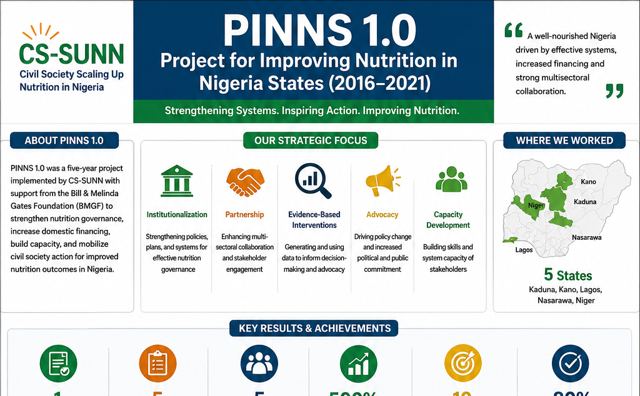
Related projects
PINNS 2.0: Partnership for Improved Nigerian Nutrition System
Nutrition budgets rose in all five states; 27 State Houses formed nutrition committees.
View project pagePINNS 3.0: Partnership for Improving Nigeria Nutrition Systems
MMS scale-up, domestic accountability and regional learning in East Africa.
View project pageTalk to the PINNS team
For partnership, data requests or media enquiries about this programme.